Sexual Empowerment Week fills an educational void

I didn’t become thoroughly educated about sex from public school. Sure, in 7th grade they taught us about the human body and the biology of sexual reproduction, but that was strictly the most basic information. I learned about birth control and different forms of sexual expression the same way most kids my age did: from my friends and from media, because it certainly wasn’t from school.

I grew up in North Carolina when state law required schools to teach only one kind of sex education in the 7th through 9th grades: abstinence. It was a system rooted in fundamentalist traditions and contingent on willful ignorance, mandating adults to tell teenagers that the only way to avoid pregnancy or sexually transmitted infections is avoiding sex; to pretend that sex is only ever safe when the participants are married to each other; and to believe that hormone-driven teenagers won’t have sex if they’re told not to.

That outdated, defunct form of sex education opts to disregard the reality of human sexuality in favor of chasing an arbitrary idealism. It’s based on the mindset that teaching teens about safe sex techniques is tantamount to encouraging their sexual activity, as if not teaching them will somehow guarantee their abstinence. Ultimately, it all comes down to the erroneous notion that it’s better for students to know less about sex than for them to be more informed.

For that reason, it was refreshing for me to see Western Carolina University host its first-ever Sexual Empowerment Week in the A.K. Hinds University Center from Feb. 4 to Feb. 7.

Dr. Marilyn Chamberlin organized Sexual Empowerment Week at WCU. Photo by Ben Haines.

Among the featured events were a question-and-answer workshop on sexual relationships on Monday, Feb. 4 in the U.C. Multipurpose Room, titled “All You Ever Wanted to Know About Sex but Didn’t Learn in High School.”

The main event was the Sexuality Exploration Fair in the U.C. Grand Room on Thursday, Feb. 7, featuring booths with information on sexuality, sexual options, sexual identity, and sexual health.

Sexual Empowerment Week was organized by Dr. Marilyn Chamberlin, associate professor of anthropology and sociology at WCU.

“I hoped to have students gain the knowledge about sex so they can have physically and emotionally safe relationships as well as learn about the diversity of sexual identities,” said Chamberlin.

Many students with uncertainties or questions about sex avoid seeking out answers for a number of reasons. Sometimes it’s out of embarrassment, due to either shyness or shame of not knowing. Other times it’s out of conditioning, having been raised to regard sex as a taboo subject and simply not talk about it.

“I wanted to have something where students could come with a level of anonymity and find out what they want to know,” said Chamberlin. “They don’t have to feel awkward. They can get that information.”

Dozens of students turned out for the Sexual Empowerment Week events to learn about a wide range of sexual topics and gain new perspectives on their own sexual identities.

“I received overwhelming positive feedback from students,” said Chamberlin, “ranging from ‘You told us it was okay to not have sex,’ to ‘Wow, I didn’t know some of this and I plan on being a sex educator,’ to ‘You answered our questions honestly.’”

Any form of non-traditional sex education in a public institution is bound to incur the wrath of at least one requisite moral objection. There were no complaints about Sexual Empowerment Week from within the community, no protests on the WCU campus, and Chamberlin never received any hate mail. Of all the places for the token opposition to come from, an article titled “S&M at WCU” was posted to TownHall.com by Dr. Mike Adams, a professor of sociology and criminology at UNC Wilmington.

It’s unusual for WCU to receive attention from the world outside the Great Smoky Mountains for anything that doesn’t pertain to our rival basketball team’s free-throw prowess. The article is more amusing for Adams’ sensationalist rhetoric, factual errors and paranoid overtone than his repeated attempts at lowbrow sex jokes.

“Each day will feature an event funded by North Carolina taxpayers,” Adams wrote of Sexual Empowerment Week with zeal. It’s an alarming proclamation that stirs up just the right level of gut recoil when taken at face value, but it’s also misleading.

Of the five events featured during Sexual Empowerment Week, only one of them cost any money, with a budget of $400. That came from the Women’s Studies budget, which is partly made up of money provided by the state but also includes tuition paid by the students taking the classes as well as a development fund that is based on donations only.

Dr. Marsha Rand

The whole $400 budget was spent bringing guest speaker Dr. Marsha Rand, a marriage and family specialist and certified sex therapist in charge of the Sexual Well-Being Asheville clinic and the founder and clinical director of the Maitri Center for Women, both in Asheville, N.C.

“The $400 came from the Women’s Studies budget that is set aside for guest speakers,” Chamberlin explained, “which include speakers for Women’s History Month, the Gender Conference and to support other programs in bringing in visiting scholars.”

Rand hosted a group discussion on healthy relationships in the U.C. Multipurpose Room last week. Sitting in a circle of chairs, more than 25 students joined Rand to talk about relationship norms on campus and share personal experiences.

The rest of the Sexual Empowerment Week events were entirely the result of volunteer work. Several of Chamberlin’s students along with two nursing students volunteered their time and began organizing the week’s events in September 2012.

Barbara Starnes hosted a panel on safe sex methods in the U.C. Multipurpose Room on Wednesday, Feb. 6. Jennifer Berry and Ashley Reddy, two nursing students who took part in the safe sex panel, also hosted a booth at the Sexuality Exploration Fair with information packets on safe sex techniques and sexually transmitted infections.

“STIs are really rampant,” said Berry. During their time in the WCU nursing program, she and Reddy have seen many students come into the health center with advanced infections that have gone untreated.

Students with STIs commonly have misconceptions about how they can spread, the signs and symptoms of different kinds of STIs, and how they can be treated.

“I think people are becoming more concerned and want to get educated,” said Reddy.

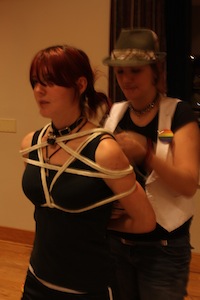
Jessica Lloyd and Heather Rice demonstrate bondage techniques at the Sexuality Exploration Fair. Photo by Ben Haines.

One of the sexual practices showcased at the Sexuality Exploration Fair was BDSM, a portmanteau of bondage and discipline (B&D) and sadism and masochism (S&M). BDSM has recently gained widespread mainstream attention due to being featured in the global bestseller Fifty Shades of Grey, a 2011 novel by author E. L. James.

“We decided to do the bondage booth because Fifty Shades of Grey hit so big and there is so much misinformation in there,” said Chamberlin.

Rather than accurately reflecting a real-life BDSM relationship, the book “actually presents an abusive relationship,” said Jessica Lloyd, one of the students minding the BDSM information booth at the Sexuality Exploration Fair.

“When it comes to the BDSM culture, everything is negotiated. Everything is known,” said Heather Rice, the other student hosting the booth. She explained that the book’s depiction of one-sided decision-making and characters who ignore their partner’s use of safety words fails to illustrate the trust that BDSM relationships are built upon.

“The reality is that Fifty Shades both misrepresents dominant/submissive relationships, and is also very popular,” said Tiffany Thompson, a WCU graduate with a master’s degree in professional writing who now lives in Los Angeles. A copy of the book featuring handwritten liner notes by Thompson and two other WCU students was featured at the BDSM booth at the Sexuality Exploration Fair.

“Without educational panels, such as the ones being organized at WCU, young girls may think it’s both sexy and okay to be controlled by jealous men prone to violence,” said Thompson. “Certainly, the cultural perception of what is perverse adds to the psychological stimulus of participating in behaviors thought to be ‘wrong’ or ‘dirty,’ but the focus of these relationships, much like any other, should be trust, vulnerability, and communication.”

Chamberlin and her students hosted a book discussion titled “Shades of Grey: The Reality” with attendees in the U.C. Grand Room immediately following the Sexuality Exploration Fair.

At the beginning of each semester, when Chamberlin gets a new roster of students in her marriage and family class, she gives them a 28-question survey to gauge where they stand with regard to sexual knowledge and misconceptions. Her students are typically unsure of or mistaken on more than 20 of the questions.

“I am amazed at how many students are confused and just don’t have the information,” said Chamberlin. “I think the reason is the lack of education about this.”

North Carolina recently made breakthrough progress on sex education. In 2009, Gov. Bev Perdue signed the Healthy Youth Act into state law, requiring schools to offer comprehensive sex education that teaches students about contraceptives and STIs in addition to abstinence, beginning with the 2010-2011 school year.

But students at WCU today who grew up in North Carolina received a very different kind of sex education. For fifteen years, a 1995 state law required schools to teach abstinence-only sex education in the 7th through 9th grades.

I attended a public middle school in North Carolina from 2000 to 2003. From my own firsthand observation, I can attest to the inefficiency of abstinence-only sex education and its failure to connect with students.

One day in 7th grade at Cleveland Middle School in Garner, we students were dismissed early from our 4th block classes, divided into several alphabetical groups by our last names, and relocated to a few select classrooms. Through the school’s closed-circuit television system, we were shown a video about why abstinence from sex was the one and only safe choice for us young teenagers, complete with ham-fisted dialogue and gloriously bad acting.

One of the skits featured a teenage girl pressuring her boyfriend to have sex with her. He responded to everything she said with “No, I don’t want to get you pregnant,” until she finally smiled and exclaimed, “Oh, you’re so sweet!” End skit. Every 7th-grader in the classroom burst out laughing.

In 8th grade, they gathered all of us into the cafeteria for a discussion panel on sexual abstinence featuring several young adults who became parents when they were teenagers.

At the beginning of the panel, the host encouraged us to listen to the guest speakers’ stories and ask them questions, but she quickly clarified to the audience of 8th-graders, “We’re not allowed to talk to you about birth control or anything like that.” Any approach to sex other than abstinence was treated as though it did not exist, which sucked the credibility out of that panel right from the start.

The years that followed showed just how well that abstinence-only sex education worked. In 2006, North Carolina had the ninth-highest teen pregnancy rate in the United States. I attended West Johnston High School during that time, less than five miles away from Cleveland Middle, and I couldn’t walk through the halls between classes without passing by at least one pregnant student.

Such a high rate of teen pregnancy could have been avoided if my middle school generation had been educated about ways to prevent pregnancy. If that abstinence panel in 8th grade had also included an informational booth about contraceptives, like the one that was available to WCU students in the U.C. Grand Room last week, there could have been significantly fewer pregnancies among my peers in high school.

That is the kind of educational outreach Chamberlin sought to achieve at WCU with Sexual Empowerment Week. It’s easy to dismiss sex education as unnecessary or unimportant if one feels that they already have all the knowledge about sex that they will ever need, but the reality is that not everyone is as informed as everyone else, especially if they grew up with inefficient sex education.

Although Chamberlin had not planned to make Sexual Empowerment Week into an annual event at WCU, the enthusiastic response from the community seems to have already decided that for her.

“I’ve talked to students and faculty who’ve said they would love to get involved next year,” said Chamberlin, “so we’ll see.”


The opinions expressed in this article are solely those of Ben Haines.

Freelance writer analyzes sex in new book

“My hope is for young people who feel anxious about their sex lives or relationships in one way or another to realize that they’re not alone, they’re not abnormal,” Hills said. Photo by Ben Haines.

If you’re a member of Generation Y, what book do you think best addresses sex and relationship norms on a broad-scale cultural level for people your age?  Can you even think of one?

That was the dilemma for Rachel Hills, 29, an Australian-born, England-based freelance journalist, blogger and graduate of the University of Sydney.  She is touring North America conducting research for her upcoming book, “The Sex Myth.”

Her travels brought her to Western Carolina University on Wednesday, March 14.

Hills’ book will focus on sex and identity among Generation Y, specifically people aged 16 to 35 in English-speaking countries.  It will present a mixture of accessible academic theory, popular culture and plenty of interviews.

Hills is currently traveling through the United States and Canada interviewing people for the book.  She previously conducted Skype interviews with several Americans around the country and then mapped out her trip based on whom she wanted to meet and interview in person.

“One of the things that’s been really heartening for me is the response from people who want to be involved,” she said.  “I’ve had far more volunteers than would be humanly possible for me to interview.”

Hills has interviewed about 120 people so far in Australia, the U.S. and the U.K.  She plans to interview between 150 and 200 people.

Hills has written for publications such as Cosmopolitan and Vogue, making her no stranger to the topic of sex and relationships.  Though currently residing in London, the Sydney native does most of her freelance writing for Australian and American publications.

A renowned feminist, Hills cites “The Beauty Myth” by Naomi Wolf and “The Whole Woman” by Germaine Greer as two of her inspirations growing up.  “My personal experience made sense in a broader social, political and cultural context,” she said of those books.

“I realized in my mid-twenties that there was no book out there that covered sex from a socio-cultural perspective,” Hills continued.  “There were ones that covered it from a feminist perspective or a queer theory perspective but none that incorporated all people whether they’re straight, gay, men or women.”

Hills hopes that “The Sex Myth” will fill that void for young people today, helping them understand how their approach to sex and relationships is shaped by society and culture.  “I want to make the book that my 23-year-old self would have appreciated having,” she said.

“My hope is for young people who feel anxious about their sex lives or relationships in one way or another to realize that they’re not alone, they’re not abnormal,” Hills said.

“The Sex Myth” will be released in the second half of 2013 by Simon & Schuster.

Born to write

Rachel Hills grew up in suburban Sydney, Australia, a city of 4 million people.  She displayed a passion for writing and journalism from a young age.

“When I was in fifth grade,” she reminisced, “I temporarily started up a farce newspaper for my friends about what was going on in our class of 30 people.”

At 16, Hills created her own website and decided to pursue journalism professionally.  After high school, she attended the University of Sydney, majoring in communications, English and gender studies. While in college, Hills wrote for both of the campus newspapers and worked as an editor for the university magazine, The Union Recorder.  She published her first piece in a major newspaper just before her 23rd birthday.

Today, at 29, Hills has written over 200 feature articles, essays, reviews and opinion pieces for magazines, newspapers and websites in Australia, the U.S. and the United Kingdom, according to her website.  Her blog, Musings of an Inappropriate Woman, was named Australia’s Best Feminist Blog by Weekend Australian Magazine in 2009 and earned Hills a nomination for Cosmopolitan’s Fun Fearless Female Award in 2010.

After two days in the Raleigh-Durham-Chapel Hill research triangle, Hills spent Wednesday, March 14 at WCU as a special guest speaker at a discussion workshop on gender and society.  The session was hosted by associate professor of sociology Heather Laine Talley’s feminist theory group as part of WCU’s 11th annual Gender Conference.

Hills only had one day to spend in Western North Carolina.  She flew out of Asheville to New York City the next morning to continue her tour of research across the country.

Want to get in touch with Rachel Hills?  Visit her website and follow her on Twitter @rachelhills.

Switch to our mobile site