A thrill of a ride

Brian Arrowood's adiction to wrestling brought many friends and adventures. Photo used with permission.

“It’s the most addictive drug on the planet. You can’t just quit.”

Brian Arrowood is an addict. In just five years, he has sacrificed family events, holidays, birthdays, relationships, and job opportunities to get his fix. He routinely risks life and limb just to get his high.

“It’s that adrenaline rush man, it’s always something different every time.”

Brian is a professional wrestler.

Despite the blood, the pain, and the struggles, he wouldn’t change a thing. If you were to ask him, Brian would tell you that working as a professional wrestler is the best thing he’s ever done in his life. “Everyone says it’s about that emotional roller coaster ride you take the fans on, but what no one is saying, is it’s about the roller coaster ride you are on.”

A Southern boy from a tight Irish family, Brian grew up with wrestling. His mother, who worked in the business before he was born, would tell him stories of traveling the United States and performing in –front of fans, making money and spending time with her friends. His father, who follows Brian to his shows today, would sit down with him every week to watch World Championship Wrestling (WCW) and then named World Wrestling Federation (WWF). These childhood memories would ultimately drive Brian to enter the ring himself.

I first met Brian in high school. We had class together, but never spoke to one another; I’d wager that he probably didn’t know I existed. Brian, a natural showman, was more comfortable in front of a crowd than behind a desk, was commonly found trying to find some way to make other students laugh with his antics. By the time our senior year rolled around, it was not uncommon to hear people clapping for him every time he entered a room.

The first time I had ever spoke to Brian was in 2008, over a year after we had graduated. I happened to bump into him at a local electronics store, and he offered me a spot playing bass in a band he was trying to create.

After several months of failing to get the band off the ground, Brian and I decided to scrap the project and move on to something else.

When he couldn’t find anything else he wanted to do, Brian turned to wrestling, but he didn’t to go into the business solo, so he called me. “I was like, ‘he’s probably going to laugh at me and call me a queer’ but why not?”With some reluctance, I agreed, and before I knew it, we were in an 18 x 18 ring, taking bumps and bouncing off the ropes, training to be professional wrestlers.

We made our in-ring debut on July 4th, 2009 in an over the top battle royal, and every Saturday night for the remainder of that year, Arrowood and I worked at APW as “Brian Thrill” and “Dustin Ride” and together we were the tag team “Thrill Ride.”

By the winter of 2009 Brian was working three shows a week all over North and South Carolina, while I was home nursing an injured ankle.

In 2010, he hit the road with a group of wrestlers he had met the previous year and began traveling all over the Southeast for the better part of the year.

“I’ve slept on so many promoters couches and in their floors it’s not even funny.”

Brian’s hard work earned him an invite to Mexico, where he worked an trained for a month.

By 2012, Brian was working four to six shows a week, often in different state. In December of 2012, after nearly five straight years of non-stop traveling, he finally decided to take a break. He traded his championship gold in for a wedding ring, and has been out of action since. He is currently working as a welder in his dads auto repair shop.

Brian admits that he can’t stay away from wrestling forever. While he doesn’t plan to travel as much, Brian will be performing across North and South Carolina through the Spring and Summer of 2013. He also hopes to open his own promotion within the next year.

Success becoming a habit for Catamount Track and Field

For some teams, winning every now and then is tough enough. Being competitive on a consistent basis is even more of a challenge.

The Western Carolina University track and field team have proven that they can do both. The team continues to build a winning tradition, claiming victory for men and women in the 2013 Southern Conference Outdoor Championship.

The team looks to add to their success at the NCAA tournament. Their journey to nationals starts on May 23, when qualifiers for the NCAA East Regional begin.

For the complete story, please watch this video…

Ultimate Frisbee at Western Carolina University

The WCU Ultimate Team poses for a picture after their first tournament in October 2012. Photo by Cariah Orlowski.

“We’re not just a bunch of hippies throwing a disc around.”
That’s the message that Joe de Give, captain and vice president of the Ultimate Frisbee team at WCU, wants to get across to people.
In Fall 2012, Joe and a friend of his restarted the Ultimate Frisbee Club at Western that had been reformed and fallen apart several times. While de Give doesn’t consider himself a founder, he’s “pretty much taken over leadership of [this incarnation of] it”, and is “the reason why it’s still running”, and he may have a point.

The club has to go through a lot of bureaucracy to ensure that they are allowed to practice and travel to tournaments. The president, who at the beginning of the year was de Give, has to go to the Campus Recreation department and fill out multiple forms, making sure that the school isn’t liable for injuries sustained while on tournaments and that the club represents the school in a fitting way. The current version of the club is in its first year, with its president Matthew “Micky” Haynes, and vice president Joe de Give.

The  staff advisor of the club, Chris Parrish, who works at WCU as the Senior Director of Admissions is responsible for, as he says, “making sure that the Ultimate Frisbee organization is following the rules and guidelines set by the Campus Recreation Department”. He makes sure that practice is being run safely and that the students are properly representing the university. [Read more...]

Fishing: a line and a lure

Every spring, the white bass converge on the rivers in North Carolina, gliding upstream to participate in spawning rituals that result in waters overflowing with the silver-bodied fish. If fishermen calculate correctly, they will find themselves ripping these fish out of the water faster than they can reel.

“I’ve had days when I’ve literally caught so many of ‘em my arms ached,” said Bill Hoy of Fredonia, Tennessee in an article about white bass on the Bass Pro Shops website by Wade Bourne.  “If you just like hooking and playing fish, it’s hard to beat white bass when they’re running.  And another good thing: methods and locations for doing this are simple. These fish are easy to catch.  Anybody can do it with some basic know-how and tackle and a fair measure of persistence.”

When the white bass will run upriver is determined by a combination of water temperature, current and light intensity. According to John Riddle, a fisheries biologist with the Tennessee Resources agency, the white bass school up, wait for the right conditions and then swim upstream, which accounts for the high density in which they move upriver. The water temperature typically must reach the high fifties and then the males will start running, with the females following within one or two weeks.

Matt Bodenhamer, an avid white bass fisherman and a fish and wildlife major at N.C. State University, suggests using a three-inch swim bait — a soft, plastic bait that mimics a small minnow — attached to a white 1/16 to 1/8 ounce jig head and to keep the gear, such as the reel and line, light.

“The best colors are black and white or solid white colors,” Bodenhamer said. “We have used several lure manufacturers and as long as the color scheme is correct, they will all produce outstanding results. Second-best would be a white doll fly.”

Bodenhamer prefers to use a 5 1/2 or 5-foot cherrywood rod. “Reels can vary for however much you’re willing to spend, but I use a Pfleuger presidential ultra-light reel,” he said. “Keep it light with the line; I use no more than 6-pound test. The thicker lines give the baits less natural and less desirable action when in the water.”

When fishing in partly cloudy or murky water, Bodenhamer suggests using natural-looking swim baits such as black and using white baits for clear water.

“If a bait is too bright in these types of conditions, it causes the bait to give off an unnatural glow which will spook fish rather than attract. Clear, sunny days with clear water are better for the all-white bodied baits,” Bodenhamer explained. “The super bright colors catch the eyes of the white bass quicker and cause instinct strikes. They can also see the bait at a farther distance. The same methods apply to doll flies and both baits should be cast and retrieved slowly.”

Fishing for white bass can be fun for anyone looking to relax or catch some dinner. If calculated correctly, white bass are a fun, easy catch.

“The year 2010 was the most remarkable,” Bodenhamer recalled. “Within a day, my father, cousin, and a family friend caught 118 and kept almost 60 of them to eat.  When running at their full potential, on average, we can catch about 30 a day.”

While the white bass is native to northern habitats, they have been largely introduced in waters across the south and are distributed widely across the United States. As they typically run from mid-March until May, there is a good chance if you visit a river in Western North Carolina during these months you’ll have a fishing experience like nothing else, and your arms just may get tired.

The waters of WNC are great for catching other fish as well.

Western North Carolina offers many guided fishing services. AB’s Fly Fishing Guide Service has been in business for 30 years.

Hooker’s Fly Shop and Guide Service, located on Main Street in Sylva, offers guided trips on the Tuckasegee River, Oconalufte River, the Raven Fork Trophy Water and many other areas in WNC.

NFL veteran David Patten returns to WCU

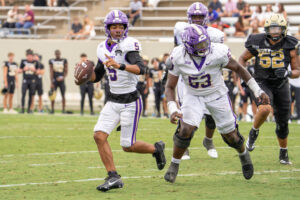
Former catamount and 12-year NFL veteran David Patten (Photo courtesy of the WCU Athletic Department)

Western Carolina’s football program has been in a tailspin over the last seven years, not seeing a winning season since posting a 5-4 record in 2005. With the hiring of Athletic Director Randy Eaton and Head Football Coach Mark Speir just a year ago, the foundation for turning this program around has been laid.

In February 2013, Western Carolina added another key ingredient to the mix. Former Catamount wide receiver (1992-1995) and 3-time Super Bowl champion David Patten, has joined the WCU coaching staff. Patten is a 12-year NFL veteran having played for the New York Giants, New England Patriots, Washington Redskins, New Orleans Saints and the Cleveland Browns.

During his standout career with the purple and gold, Patten hauled in 96 receptions for 1,563 yards and 14 touchdowns. He was a member of the “three amigos” that made up the Catamount receiving attack along with Kerry Hayes and Craig Aiken.

After his days in the valley, Patten was ignored by the NFL during the 1996 draft and was cut loose by the Edmonton Eskimos of the Canadian Football League (CFL). He fell completely out of football and found himself working back home in a South Carolina warehouse.

“I came back home and I’m working in a coffe bean factory. At that time it appeared that your dream isn’t going to come to fruition,” said Patten. “I continued to believe, and at the time I couldnt really workout, but I knew in my mind and in my heart I still wanted to play.”

Patten finally got his shot at the NFL when he was signed by the New York Giants in 1997. Seeing limited opportunities at receiver, Patten’s main role with the Giants was on special teams as a kick returner. After three years with the Giants, he was yet again, released. His career received a shot in the arm when he was signed by the New England Patritots in 2001.

Perhaps the most decorated of Patten’s career, was his stint with the New England Patriots (2001-2004). In 2001, in a game against the Indianapolis Colts, Patten became only the sixth NFL player to throw, catch, and rush for a touchdown. He took one to the house off a 29-yard end-around; he caught a 91-yard bomb from quarterback Tom Brady; and topped it off by slinging a 60-yard option pass to wide receiver Troy Brown. He accounted for a total of four touchdowns that day against the Colts.

Patten really blossomed during his time with the Patriots. Along-side Tom Brady, he was a part of three Super Bowl championship teams (2002, 2004, 2005). His performace in Super Bowl XXXVI agianst the St. Louis Rams was nothing shy of spectacular. During the second quarter, Patten reeled in an 8-yard touchdown in the back corner of the end zone, helping his Patriots to a 20-17 victory to capture his first ring.

“My dream had come true. Everybody dreams of catching a touchdown pass in a Super Bowl and I achieved that,” Patten said. “It was as if all of the hard work, all of the set backs had made it that much sweeter. It made it all worth it.”

The success carried over for Patten in the following season where he amassed career highs in receptions (61) and yards (824) along with five touchdowns. After claiming his third ring in Super Bowl XXXIX, Patten was surpassed by the next batch of great Patriot receivers, David Givens and Deion Branch. From 2004 until 2010, Patten bounced around through free agency to different teams until finally announcing his retirement on July 31, 2010. Patten’s final tallies were impressive as he carved up defenses for 324 receptions, 4,715 yards and 24 touchdowns. With his versatility, he spent some time in the backfield as well as a kick returner on special teams. The do-it-all receiver gobbled up 106 yards on the ground off 13 carries and a touchdown. He piled on 2,273 additional yardage and a touchdown while returning kicks.

On February 11, 2013, Western Carolina announced that David Patten is returning to WCU, this time as a member on the sideline.

“We’re very excited that David Patten is joining our football coaching staff for the 2013 season,” said Speir during the press conference in February. “David will bring a lot of energy, knowledge and passion to our program. Having someone like David with 12 years of NFL experience and three Super Bowl rings around our players and coaches will be a tremendous asset and boost to our program. He knows what it takes to compete at a high level and it’s awesome to be able to have a guy on staff that came through our program at Western Carolina and excelled on the highest stage.”

During Patten’s playing days at WCU, Speir was on the sideline as an assistant. They each left to pursue other careers in football, and now over a decade later, both have returned as coaches.

“Coach Speir called me out of the blue and asked me if I would be interested in coaching and I felt, ‘Hey lets give it a shot’ and see what comes out of it,” Patten said. “As a player, one of my strengths has always been the ability to motivate my fellow teammates and I felt with my experience, I can help instill within them the work ethic, and doing things the right way to give them the opportunity to be successful and help get this program turned around.”

David Patten discusses his football career at Western Carolina University (Interview conducted by Philip Jackson, video provided by Caleb Rutherford)


Impact of Tuck River cleanup

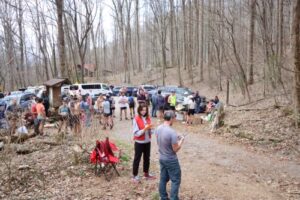
Troy Adams, WCU graduate student finds hubcap at Tuck River Cleanup

Western North Carolina is committed to maintaining the serene beauty that the region has to offer. This year marks the 29th anniversary of the Tuck River Cleanup, a testament to the support of the community at Western Carolina University.

“The Tuck River Cleanup is our yearly rehabilitation effort to maintain the natural beauty of this important resource”, said Jenna White, graduate assistant at Base Camp Cullowhee.

The Tuck River Cleanup has a significant ecological impact on the area. The importance of cleaning the Tuckaseegee River specifically, is that it has a huge watershed that flows through all of Jackson County. The river begins above Cullowhee, goes through the Glenville reservoir and flows through Panthertown Valley all the way to Fontana.


The amount of trash collected from the Tuck River Cleanup into Fontana is immense.  Several tons of trash is removed each year from the Tuckaseegee River as a result of the annual cleanup. This year, two 30-yard rollout containers, each half-filled with garbage were collected. Some of the most common things removed include shopping bags, tires, cans and bottles.

“It’s great to see students from different areas to take such a strong involvement to clean our county’s resources,” said Jennifer Bennett, assistant director of outdoor programs at Base Camp Cullowhee.

Approximately 670 people attended the Tuck River Cleanup this year. The cleanup took place from the start of Cullowhee Dam to Barker’s Creek and this stretch was cleaned continuously throughout the day.

Scott’s Creek in Sylva is a major tributary of the Tuckaseegee River and the amount of trash in that area is substantial. The Rotary Club and the Watershed Association of the Tuckaseegee River (WATR) have cleaned different stretches of Scott’s creek this year.

Nantahala Outdoor Center and Duke Energy were major contributors to the cleanup initiative this year. Their involvement reflects the importance of the Tuck River Cleanup to the community and shows their commitment to environmental issues.

The Tuck River Cleanup is the largest event that Base Camp Cullowhee puts on annually in numbers of participants. The Tuck River Cleanup was started in 1984 with several faculty members and students in canoes cleaning up the river. It has since evolved into the largest single-day river cleanup in the United States.

“The Tuck River Cleanup is a great opportunity for students and community members to work collaboratively on an important project”, said Bennett.

Related Posts:

Spring cleaning the Tuck

Switch to our mobile site