Cadaver dog training at WCU

Bridget picks up the scent of human decomposition and sets out to locate the source. Photo by Ben Haines.
Caption
Bridget picks up the scent of human decomposition and sets out to locate the source. Photo by Ben Haines.
Bridget gives her trained final response, sitting, after correctly determining that the source of human decomposition odor is beneath the bridge. Photo by Ben Haines.
Caption
Bridget gives her trained final response, sitting, after correctly determining that the source of human decomposition odor is beneath the bridge. Photo by Ben Haines.
Deputy Kathy Adamle takes her newest puppy, Bridget, on WCU's level two cadaver dog training program with instructor Greg Cole. Photo by Ben Haines.
Caption
Deputy Kathy Adamle takes her newest puppy, Bridget, on WCU's level two cadaver dog training program with instructor Greg Cole. Photo by Ben Haines.
Brad Dennis praises Gracie after she sniffed out the trash bag emanating human decomposition odor. Photo by Ben Haines.
Caption
Brad Dennis praises Gracie after she sniffed out the trash bag emanating human decomposition odor. Photo by Ben Haines.
Gracie, Brad Dennis' puppy.  Photo by Ben Haines.
Caption
Gracie, Brad Dennis' puppy. Photo by Ben Haines.
Photo by Ben Haines
Caption
Photo by Ben Haines
Photo by Ben Haines
Caption
Photo by Ben Haines
Deputy Kathy Adamle and Jake. Photo by Ben Haines.
Caption
Deputy Kathy Adamle and Jake. Photo by Ben Haines.
Deputy Kathy Adamle and Bridget. Photo by Ben Haines.
Caption
Deputy Kathy Adamle and Bridget. Photo by Ben Haines.
Paul Martin hands out certificates at the conclusion of the level two course. Photo by Ben Haines.
Caption
Paul Martin hands out certificates at the conclusion of the level two course. Photo by Ben Haines.
Robin Moore smiles with her certificate after completing the level two cadaver dog training program at WCU. Photo by Ben Haines.
Caption
Robin Moore smiles with her certificate after completing the level two cadaver dog training program at WCU. Photo by Ben Haines.

The Western Carolina University Forensic Anthropology Program, in conjunction with the Division of Educational Outreach and the Human Identification Lab, hosted their latest cadaver dog training program workshop May 15 – 22.

Participants experienced instructional lectures as well as in-field exercises giving them and their canine companions valuable practice in human decomposition odor tracking and analysis.

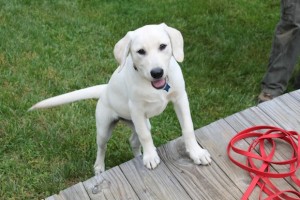
Deputy Kathy Adamle, a canine handler at the Geauga County Sheriff’s Office in Chardon, Ohio, began training dogs in 1994 and has worked with cadaver dogs since 2002. She participated in the workshop at WCU with her newest puppy, Bridget. The cream-colored golden retriever got to learn the difference between human and deer bone for the first time.

“She did a good job. She’s learning,” Adamle said. “It’s not an overnight thing. It’s constant reinforcement, two or three times a week, and I have to work my other three.”

Adamle also brought Jake, who, at a nine years old, is already an experienced cadaver dog. “I brought him along so that he could work a couple scenarios just to keep him sharp,” Adamle said.

For centuries, law enforcement agencies and militaries around the world have utilized dogs to track scents because of their profound sense of smell, with approximately 220 million olfactory receptors in their noses compared to 5 million in those of humans. Dogs can determine the direction from which a scent is traveling thanks to highly sensitive skin receptors that allow them to feel the moisture on their noses being evaporated by air currents.

“It doesn’t matter what scent you teach the dog; cadaver, narcotics, bomb work, it doesn’t matter,” said Adamle. “It’s all a game to them. They don’t get depressed. All they want is their reward. They work for a paycheck.”

Paul Martin, a graduate of WCU’s forensic anthropology program, founded the university’s cadaver dog training program in 2011 and currently serves as its program coordinator. After handling his first dog in 1997, Martin has specialized in human remains detection and recovery with canines since 2000. He is currently working with his third, fourth and fifth cadaver dogs.

The WCU cadaver dog training program holds workshops every fall and spring, with each workshop divided into two courses. The level one course ran from May 15 – 17 with a $399 enrollment fee while the level two course took place May 20 – 22 at a cost of $449.

While open to anyone, the program is not intended for casual hobbyists but for professionals. Any dogs participating in the level one course must have had a minimum of six months prior training and must know their trained final response, what their handlers have trained them to do when they smell human decomposition and locate its strongest source. A cadaver dog’s trained final response is typically to bark, sit or lie down.

The level one course is designed to introduce handlers and their dogs to large sources of human decomposition odor that they may not have been exposed to before, such as a full body, as well as help them understand the decomposition process and scent movement throughout an environment.

The level two course involves a number of outdoor search scenarios designed to reinforce the dog’s trained final response to large sources of human decomposition odors. One of these involves the dogs locating graves in a cemetery along the Tuckaseegee River, where the handlers are also exposed to ground-penetrating radar technology.

Another scenario was set up by Brad Dennis, the director of search operations for the KlaasKIDS Foundation’s Search Center for Missing and Trafficked Children based out of Pensacola, Florida.

In Dennis’ real-world scenario, handlers and their dogs must traverse unfamiliar woodland terrain near the WCU campus, searching for hidden items that are imbued with the scent of human decomposition. While the dogs can detect the scents from far away, the goal of the course is for them to locate the source of the odors and grow accustomed to zeroing in on the largest quantity

“It’s really amazing to watch the progression that the dogs working that area make throughout the day,” Martin said, “from being a little bit hesitant and not wanting to give its full trained final response to, by the end of the day, offering those trained final responses without any prompting by the handler.”

Since offering the first cadaver dog training course at WCU in May 2011, Martin has received many letters from handlers who went on to conduct searches for human remains and make successful recoveries with their dogs.

“One handler in particular,” Martin recalled, “everybody on her team, the law enforcement that she worked with, they were just amazed how the dog actually took them all the way to the remains and gave that trained final response there at the remains.”

Greg Cole, a retired captain of the Gulf County Sheriff’s Office in Port St. Joe, Florida, has trained dogs for military and law enforcement since 1976. He began working with cadaver dogs about 13 years ago and served as an instructor in the WCU workshop this past week.

“I was honored to come out here and help at Western Carolina University,” said Cole. “Best cadaver dog training program in the country.”

Marine and plant farming merge in aquaponics

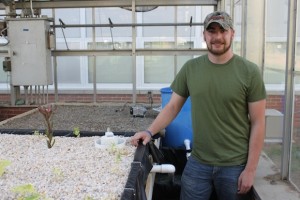
Randy Reinke built this aquaponics system in the WCU campus greenhouse.  Photo by Ben Haines.
Caption
Randy Reinke built this aquaponics system in the WCU campus greenhouse. Photo by Ben Haines.
The aquaponics system consists of a gravel bed containing plants and a water tank filled with fish.  Photo by Ben Haines.
Caption
The aquaponics system consists of a gravel bed containing plants and a water tank filled with fish. Photo by Ben Haines.
The fish tank is populated by koi and goldfish.  Photo by Ben Haines.
Caption
The fish tank is populated by koi and goldfish. Photo by Ben Haines.
Before the water even enters the fish tank, this machine dechlorinates it.  Photo by Ben Haines.
Caption
Before the water even enters the fish tank, this machine dechlorinates it. Photo by Ben Haines.
As the fish live and eat in the tank, the waste-filled water is transferred through this hose into the gravel bed, where bacteria break down the nitrogen byproducts in the water and leave the waste nutrients behind for the plants to consume. Photo by Ben Haines.
Caption
As the fish live and eat in the tank, the waste-filled water is transferred through this hose into the gravel bed, where bacteria break down the nitrogen byproducts in the water and leave the waste nutrients behind for the plants to consume. Photo by Ben Haines.
This filter cleans the water in the gravel bed so it can be recirculated into the fish tank.  Photo by Ben Haines.
Caption
This filter cleans the water in the gravel bed so it can be recirculated into the fish tank. Photo by Ben Haines.
The freshly cleaned water drains back into the fish tank through this pipe.  Photo by Ben Haines.
Caption
The freshly cleaned water drains back into the fish tank through this pipe. Photo by Ben Haines.
This device feeds the fish.  Photo by Ben Haines.
Caption
This device feeds the fish. Photo by Ben Haines.
Cullowhee lilies.  Photo by Ben Haines.
Caption
Cullowhee lilies. Photo by Ben Haines.
Zinnia.  Photo by Ben Haines.
Caption
Zinnia. Photo by Ben Haines.
Young cucumber plants.  Photo by Ben Haines.
Caption
Young cucumber plants. Photo by Ben Haines.
This mysterious flower was retrieved from a discarded Easter bouquet in the trash at Scott Residence Hall. It was initially red and tightly packed but it bloomed when planted. Photo by Ben Haines.
Caption
This mysterious flower was retrieved from a discarded Easter bouquet in the trash at Scott Residence Hall. It was initially red and tightly packed but it bloomed when planted. Photo by Ben Haines.

Randy Reinke is a new graduate of Western Carolina University with a bachelor of science degree in natural resource conservation and management. He spent his senior year developing a fully functional aquaponic farming system in the WCU campus greenhouse.

What is aquaponics? It is a hybrid of two different farming techniques.

The cultivation of plant life in water is called hydroponics, while the raising of aquatic animals in tanks is known as aquaculture. Aquaponics combines both of these practices to create a symbiotic food production system.

An aquaponic system consists of a water-filled tank containing marine organisms and a bed of growing plant life, with machines that keep the two groups sustained by each other’s biological processes. It allows farmers to grow healthy fish, prawns or crayfish together with vegetation in a very efficient, interconnected setup.

As the aquatic animals live and eat in the water, waste and other effluents accumulate over time. The waste-filled water is transferred through a hose into a bed of soil or gravel.

Bacteria in the bed act as a biofilter by breaking down the harmful nitrogen byproducts in the water while leaving behind the waste nutrients which feed the plants. The water is then siphoned through a filter, cleaned and redistributed back into the marine tank.

Because the plants use marine animal waste as food, there is no need for fertilizers, which can cause dead zones when they enter streams, lakes and oceans. The entire process is designed to have as minimal of a lasting impact on the environment as possible.

“Our current farming practices are destroying our land and our water, so it’s very important that we begin to explore new and more efficient ways to grow our food without the destruction to the environment,” Reinke said.

Reinke first got involved with aquaponics when his neighbor asked for help to build an outdoor aquaponic system. “It captured my interest because while we were building the system, most of the country was experiencing a drought,” Reinke said. “Aquaponics has been recorded as using as little as 10 percent of the water that traditional field crops require.”

After helping his neighbor, Reinke built his own aquaponic system in his apartment. He then asked his university advisor, Dr. Brian Kloeppel, about making a school project out of it. Kloeppel suggested that Reinke build another system in the campus greenhouse.

“I wasn’t sure at first,” Reinke said, “but then I realized it would be a good opportunity for me to use the system as a model for a small business plan and would allow students to see a non-traditional food production method that, if done right, can be much less harmful to our water and soil.”

Reinke got permission to use the greenhouse from Dr. Kathy Mathews, who was more than happy to allot him the space. He then submitted proposals for grants to the Honors College, the Natural Resources Conservation Management Department (NRCM) and the Quality Enhancement Plan (QEP).

Kloeppel proofread the proposals and wrote letters of endorsement saying that he believed the funds would be put to good use and the project would be completed. “I couldn’t have built this system without him,” Reinke said.

Reinke received the grant from the Honors College but was denied the QEP grant. However, the NRCM Department not only approved him for the NRCM enrichment funds but also allocated some of the QEP funds that the department had received this year. Additionally, Dr. Jerry Miller provided money from the Blanton Whitmire Endowment to buy gravel.

Anna Thompson of the Department of Geosciences and Natural Resources and Bonnie Beam of the Honors College helped out by using the grant money to make all of the purchases for Reinke’s system with university credit cards and purchase orders.

Since Reinke did not get the total amount of money he had requested in grants, he got creative and redesigned his aquaponic system to be more cost-effective. He built the fish tank out of reclaimed lumber instead of buying a new one.

When it came time to select fish for his system, Reinke applied for an aquaculture permit for tilapia with the N.C. Department of Agriculture. Though he was approved, Reinke had a difficult time obtaining the fish so he tried to get catfish instead.

Unfortunately, the truck transporting the catfish broke down in transit and it would have been another month before the next delivery, so Reinke opted to go with koi and goldfish. “Although they are not edible, they produce a ton of waste and are great for aquaponic systems,” Reinke said.

Reinke planted vegetables including cucumbers, bell peppers, Cherokee purple tomatoes, peas and lettuce, as well as several wildflowers such as morning glories and Cullowhee lilies. Reinke selected Cullowhee lilies because he hoped it would help draw interest and possibly provide a way to breed them so people can plant them around Cullowhee.

Now that Reinke has graduated, the fate of his aquaponic system in the WCU greenhouse is up in the air. Anja Nothdurft, president of the Campus Kitchen Garden Club, will maintain the system throughout the summer but will not be able to continue with it in the fall.

“I think it would be awesome for students, faculty and the community to get involved,” Reinke said. “I put a lot of hard work into that system and it would be a shame for it to be forgotten about when I leave.”

If you would like to help carry on the legacy of Randy Reinke’s aquaponics endeavor at WCU, send him an email at rareinke1@catamount.wcu.edu.

“I would love to show anyone interested and answer any questions they have,” Reinke said.

Angela Laird Brenton: 1953 – 2013

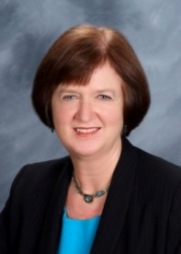
Dr. Angela Laird Brenton

Dr. Angela Laird Brenton, Western Carolina University’s provost and vice chancellor, died early Wednesday morning after a three-month battle with pancreatic cancer.

Brenton began serving as provost at WCU in August 2012 after a 16-member campus committee appointed her in May.

Brenton was born on Jan. 3, 1953, in Duncan, Oklahoma. Prior to her tenure at WCU, she served as dean of the College of Professional Studies at the University of Arkansas at Little Rock beginning in 2001. There, she worked with WCU’s current chancellor, David O. Belcher, who previously served as provost and vice chancellor at UALR.

The WCU flag at the front of campus has been lowered to half-staff in honor of Brenton. The university is offering resources for employees wishing to speak with a counseling professional.

WCU will hold a memorial celebration of Brenton’s life in the early part of the summer. Chancellor Belcher will share his plans for leadership transition in the Academic Affairs Division in the next few days.

Several of Brenton’s colleagues offered statements in her memory.

Dr. David O. Belcher, Chancellor

“We at Western Carolina University truly grieve the loss of our Provost, Dr. Angi Brenton, who died earlier today after a courageous battle with pancreatic cancer. She lived these last months with grace and has been an inspiration for us all.

I have known Angi for 16 years and can attest that she was a remarkable woman. She was a warm, caring individual with a great sense of humor. And she was a remarkable leader – one of the very best I have ever encountered. Angi had the capacity to advance an initiative but in a way that genuinely embraced others in the decision-making and implementation processes. She was a remarkable advocate for those she represented, an adept communicator on any level and in any forum, and a passionate believer in education and its transformative power in our society. Though she was only with us here at Western Carolina for a little over nine months, she leaves us changed for the better. We will miss her tremendously, but we will see her Western Carolina legacy blossom for years to come.”

Dr. Carol Burton, Associate Provost for Undergraduate Studies

“What struck us about Dr. Brenton is truly her desire to put students at the center of just about every decision she’d make. She’d come to the table and ask, ‘What impact will this have on students?’ She was just a consummate communicator. Even when she had to share bad news it came from the heart. She cared about students intently and that’s why she was in that position. She was a role model for many of us. She and I talked at length about what we loved about our jobs, our challenges. For her, I think it was being one step removed from students, but she knew that she could impact the lives of a large number of students as provost. She also had a deep and abiding respect for faculty and staff. She truly invested herself in this community. She embraced us with everything that she had.

The courageous way she fought was amazing. She was as upbeat and positive as she had been in eight months. She, in that regard, set an example for all of us in how to cope with tragic circumstances. She has many legacies but that is one that I will always cherish.”

Dr. Betty Farmer, Professor of Communication

“It is such a tragedy to lose someone who has so much to give, especially when she was at the pinnacle of her career. The suddenness of it is so sad. My heart goes out to Keith and her family and to her colleagues, especially Chancellor Belcher and Susan, who have known her for many years.”

Dr. Mark Lord, Interim Associate Provost

“As with anyone, there are many nuanced traits that are difficult to capture with a few simple sentences. As I have with many people I’ve had the pleasure of getting to know, I’ve learned much from Dr. Brenton (Angi) –some about work, some about life. At work, she had an exceptional ability to grasp the big picture quickly and convey that vision with clarity and confidence. I think the success of the many initiatives she led this past year (for example, numerous Dean searches, program prioritization, leadership institute) emanated from the clarity she gave to complex, important issues. As a person, Angi’s inner strength and independence became clear soon upon me getting to know her. In spite of the tremendous challenges she faced, her strong inner core has enabled her to stand strong and remain true to herself. She remained engaged in the high-level issues of the Academic Affairs division throughout her battle with cancer because of her care for and dedication to Western Carolina.”

For more information:
WCU Office of Public Relations: WCU mourns passing of Angi Brenton

Slayer guitarist Jeff Hanneman dead at 49

The front page of Slayer's official website pays tribute to the late guitarist.

Jeff Hanneman, a founding guitarist of the American thrash metal band Slayer, died Thursday morning of liver failure. He was 49.

“Slayer is devastated to inform that their bandmate and brother, Jeff Hanneman, passed away at about 11AM this morning near his Southern California home,” read a statement posted on the band’s website Thursday, May 2. “Hanneman was in an area hospital when he suffered liver failure. He is survived by his wife Kathy, his sister Kathy and his brothers Michael and Larry, and will be sorely missed.”

Hanneman’s liver failure followed a debilitating case of necrotizing fasciitis, a rare infection caused by flesh-eating bacteria that Hanneman contracted from a spider bite in January 2011. The infection forced him to undergo a medically induced coma, skin grafts and physical therapy, at one point nearly requiring his right arm to be amputated.

Writing for The Daily Beast, Kent Sepkowitz, M.D., an infectious disease specialist, posited that Hanneman’s liver failure was not a recent development caused by the necrotizing fasciitis but actually a long-gestating ailment that made him susceptible to the bacterial infection in the first place. “People with severe underlying medical problems, such as chronic liver disease, are at increased risk for necrotizing fasciitis,” Sepkowitz wrote.

Hanneman was born on January 31, 1964, in Oakland, California, and grew up in Long Beach. His father was a German who fought for the Allies in World War II and Hanneman held a lifelong interest in German war history and memorabilia.

Hanneman co-founded Slayer in 1981 with fellow guitarist Kerry King. The band has released ten studio albums, one cover album, two live albums and two extended plays. Slayer has been nominated for ‘Best Metal Performance’ at the Grammy Awards on five occasions, winning in both 2007 and 2008.

Slayer is known as one of the “Big Four” American thrash metal bands, along with Metallica, Anthrax and Megadeth, who are widely credited with defining the thrash metal genre in the 1980s and influencing it for years to come. In June 2010, the Big Four collaborated to play together for the first time at seven Sonisphere music festival dates in seven different European countries.

The Big Four soon planned another five-date European tour for summer 2011, as well as two special shows at the Coachella Valley Music and Arts Festival in Indio, California and at Yankee Stadium in New York City. However, Hanneman contracted necrotizing fasciitis in January of that year and was unable to play with Slayer when the band began touring that February. Slayer recruited Gary Holt of Exodus to fill in for Hanneman while he recovered.

On April 23, 2011, when Slayer played Coachella for the first Big Four performance in the United States, Hanneman surprised the crowd of 50,000 by joining his band onstage at the end of their set to play the two-song encore, “South of Heaven” and “Angel of Death.”

Holt continued to serve as the primary guest guitarist for Slayer as Hanneman continued his recovery. Immediately after his triumphant Coachella performance, Hanneman relaxed on a couch in Slayer’s dressing room and said, “I’m the happiest man in the world.” That ended up being the last time he performed with Slayer.

Holt was deeply impacted by the news of Hanneman’s passing. “Totally devastating sadness is all I have right now. ‘In shock’ are the best words I can come up with to describe how I’m feeling,” Holt said in a statement.

“Jeff, it’s been an honor, my brother, to TRY my best to honor your songs best I could,” Holt wrote. “There is only one Jeff Hanneman. All I ever could HOPE to do was play those songs you wrote with the conviction with which you played and wrote them, ’cause there is only one of you; that mold was broken long ago.”

Hanneman’s death drew an outpour of mourning through social media from artists including Zakk Wylde, Slash and Geezer Butler and bands such as Death Angel, Machine Head and System of a Down, among many others.

“Tonight one less star will be shining and sadly, the stage got just a little bit darker,” wrote Dave Mustaine, founder of Megadeth, on his band’s Facebook page.

Rob Zombie also expressed his condolences via Facebook. “I feel horrible for the rest of the guys in the band. We have done many show[s] with them over the years and they are a great bunch of guys,” he wrote.

Tom Maxwell of Hellyeah posted a photo of Hanneman onstage at a Slayer concert in 1984, showing the back of the young Maxwell’s head near the stage as he watched Hanneman perform. “I can’t express how much Slayer influenced me and help shape me into the musician I am today,” Maxwell wrote in the photo caption. “Thank you Jeff Hanneman for all the great music, memories and influence you have given to all of us fans. You will be greatly missed but your music will live forever!!!”

Watch Slayer performing “Angel of Death” in Mesa, Arizona on March 12, 1995. Hanneman wrote both the music and lyrics for this song.

Fire destroys mobile home in Sylva; no injuries

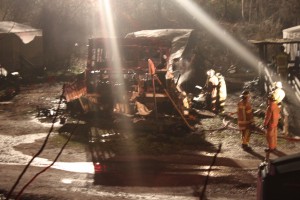
Photo by Ben Haines

SYLVA, N.C. – A mobile home went up in flames late Tuesday evening, March 19, in the Mountain Creek Estates mobile home park, causing damage to surrounding units and prompting emergency personnel to evacuate residents.

No one was injured in the blaze which destroyed one mobile home and damaged two others before firefighters brought it under control. The cause of the fire is still under investigation, according to Tim Green, Chief of the Cullowhee Fire Department.

The fire originated in the mobile home located at 159 Anvil Road, home to Billy and Connie Mills and their three children, shortly before midnight. By 1 a.m., the unit was charred a dark grey with the roof collapsed inward.

The Cullowhee Fire Department received a call about the fire at 11:45 p.m. and the first unit of firefighters was on the scene at 11:48 p.m. Todd Dillard, Emergency Management Coordinator for Jackson County, worked with the American Red Cross to assist the Mills family.

In their mobile home several units up Anvil Road from where the fire originated, residents Colin and Casey Whitfield heard a loud explosion just before midnight. “When we heard the explosion, it sounded like a gunshot a couple of trailers down from us,” Colin Whitfield said. He recalled that emergency personnel were on the scene less than five minutes later.

The fire spread from the main unit to the adjacent mobile homes on either side. The unit on the right, 161, owned by Lisa Sampson, sustained heavy fire damage in the living room as well as heat and smoke damage throughout the entire structure.

The damage to the unit on the left, 149, home to Tony and Joyce Whitmire, was comparatively mild. The fire melted the underpinning and popped several windows.

As a precaution, the Cullowhee Fire Department evacuated residents from the two nearest units on each side of the affected mobile homes until the fire was extinguished. It took roughly 30 minutes for emergency personnel to get a handle on the blaze, according to Chief Green.

“I need to know if that was a meth lab explosion, because we’ve dealt with enough meth crap in that neighborhood. They just evicted some neighbors that we knew were using meth,” said Whitfield. “I know they (Mountain Creek Estates management) have been trying to clean the place up, but I know it’s still in that trailer park.”

The cause of the fire and the explosion that preceded it is still undetermined.

WCU Dining Services seeks student input

Sarah Caruso, Mike Doppke, and Greg Smith of WCU Dining Services. Photo by Ben Haines.

WCU Dining Services hosted an open forum to gather student feedback on Monday, March 18 at 7 p.m. in the A.K. Hinds University Center Multipurpose Room B.

Representing Dining Services at the event were Sarah Caruso, Marketing Coordinator; Mike Doppke, Senior Food Service Director; and Greg Smith, Assistant Food Service Director.

WCU Dining Services holds forums like this once per semester and they are typically low-key affairs with fewer than ten people attending. Nevertheless, the three students who turned out for Monday’s session were enthusiastic to speak with Dining Services representatives.

“We really feel like we’re part of the college community here,” said Smith. “The more students, staff and faculty are involved in what we do, the better off everyone is.”

Key topics addressed at Monday’s forum included hours of operation, healthy eating options and future prospects for Dining Services.

The students in attendance agreed that Einstein Bros. Bagels could be particularly frustrating with its hours, being open only from 7 a.m. to 4 p.m. Monday through Friday and closed on weekends.

“We address our hours of operation at all of our locations twice a year,” Doppke said, writing down the students’ suggestions on a notepad. He clarified that weekend hours are influenced by the fact that a large number of WCU students leave campus every Friday and do not return until Sunday night, a trend that university officials would like to change.

On the subject of healthy eating, Smith explained that the Courtyard Dining Hall receives its menus from corporate headquarters in four-week cycles and the Dining Services staff has limited choices to make within that framework.

“We’re really making an effort to give the people who want to eat healthy a chance to eat a really good, healthy dinner,” Smith said, though he admitted that it ultimately comes down to personal student choice. “I can promise you that hamburgers outsell our vegetarian options 20 to 1.”

The flyer for Monday's forum.

Doppke cited the preset menus of national brands as an obstacle to providing more options at existing dining locations on campus. “We are working with Chik-Fil-A to try and expand their menu next year,” Doppke said. “I don’t want to talk about what they may be at this time because I don’t want to make a promise I can’t keep.”

Caruso mentioned highlighting healthy eating options at various campus locations, referring to Dining Services’ Fresh & Healthy initiative.

“There are healthy options in those locations,” Caruso said. “We have tried to make it a little more obvious.”

Doppke stated that his long-term goal for Dining Services is to add more facilities on Central Drive, close to the Harrill, Central, Buchanan and Albright-Benton residence halls. At present, only the C3 Convenience Store located in the Brown Building is available to serve that region of the campus.

As WCU’s student population continues to grow every year, resident students congregate in the facilities at the center of campus to get their meals. This is why the Courtyard Dining Hall and UC Food Court are frequently packed with crowds, and Doppke would like to redistribute some of that traffic with new dining facilities in the upper campus area.

“Even if we got 500 people a day out of the dining hall, that would make a huge difference,” Doppke said. “I think when you do see a move to expand the services in the future, it will be a comprehensive plan.”

In addition to the upper part of campus, there is also the prospect of Dining Services expanding outward as the university develops more infrastructure in the surrounding area. WCU’s new Health and Human Sciences Building recently opened on Little Savannah Road, making it the furthest outlier from the main campus and bringing about a new CatTran shuttle service traffic pattern to transport students.

WCU’s 2020 Commission will present its preliminary report for future university development by December of this year, and Dining Services will see how budget and opportunity permit them to expand with the campus. “We want to be where the people are, no question,” Smith said.

WCU Dining Services will next host a free lunch session on Thursday, April 11 at 12:30 p.m. in the University Center. Students who attend will have the opportunity to speak with Dining Services representatives one-on-one and enjoy a free meal from the U.C.’s Papa John’s Pizza, Einstein Bros. Bagels or Chik-Fil-A outlets.

Later this year, Dining Services will take part in Stop Hunger Now, a global initiative dedicated to packaging meals to service people in need. A Stop Hunger Now drive was previously held on Oct. 1, 2011 by the WCU Wesley Foundation, the WCU Teaching Fellows and the WCU Center for Service Learning, with student volunteers packing over 36,000 meals in a span of five hours.

This will be the first time WCU Dining Services hosts a Stop Hunger Now drive, and it will likely take place in late April or early May, though it might be delayed until the fall semester in August. Anyone who would like to volunteer can contact Sarah Caruso by phone at 828-227-3778 or by email at caruso-sarah@aramark.com.

Switch to our mobile site