Aftermath of Amendment One

On May 8, 2012, North Carolina passed an amendment to the state constitution decreeing “marriage between one man and one woman is the only domestic legal union that shall be valid or recognized in this State.” The controversial measure passed with 61 percent of the vote just one day before President Barack Obama became the first U.S. president to endorse same-sex marriage.

Christopher Cooper is Associate Professor of Political Science at Western Carolina University.

To understand the implications of the passage of Amendment One, WCJ spoke with Christopher Cooper, Associate Professor of Political Science at Western Carolina University.

WCJ: What might be some of the unintended consequences of the amendment’s passage?

Cooper: “This has made a name for North Carolina on the national scene, for good or for bad. I think obviously a lot of folks think this is a good thing. The majority of North Carolinians, at least the ones who voted, spoke out and said it was a good thing, but there’s still a sizable minority of people that don’t think that, and there are some folks that are claiming that this might kind of hurt the business climate of the state of North Carolina, or maybe hurt our ability to recruit businesses in the future. There are clearly millions of people who are going to feel disenfranchised by this amendment. It makes sense to me that, given a choice of where to relocate, they would choose to relocate to a state that’s more hospitable.”

WCJ: What are the options now for opponents of Amendment One?

Cooper: “To try to declare this unconstitutional at the federal level, which has never happened. This kind of thing has never gotten all the way to the Supreme Court for that kind of a decision. Also it can be taken back to the people again for another vote, and I think that’s the more likely of the two scenarios. We know that young people are much more likely to support gay rights and gay marriage than older people, so as the electorate ages, you would expect that the odds of repealing this would go up over time. We actually saw the opposite of that happen in Arizona. Arizona actually voted kind of a pro-gay marriage thing and then they went back and then voted against it. To have this be another constitutional amendment, it’s going to have to go back to the people.”

WCJ: What effects could this have on the November election?

Cooper: “Probably not a huge amount. I think people in this state don’t support gay marriage, by and large; so the more it’s talked about, the worse it is for Obama. If you’re a politician, you want the political dialogue and the debate to be on issues where you agree with the public and the public agrees with you, so this is pretty clearly a place where Obama is a little out of step with the state of North Carolina. I think to whatever degree it continues to be talked about will be a little bit worse for Obama in North Carolina.”

WCJ also spoke with people in the community to learn their thoughts about the passage of Amendment One. Here are their comments.

Ernie Jamison, pastor at New Hope Baptist Church in Sylva, N.C.
“We’re very happy about it. We believe that it confirmed the definition of marriage that God has given to us in his word, and as firm Bible believers and people that try to follow the commandments of God, we’re very pleased about it.”

Ann Fletchall, geography lecturer at Western Carolina University
“I guess I expected it would pass but I am disappointed that it did. I definitely think marriage should be an equal opportunity for everyone.”

Laura Ernst, academic advisor at OneStop, Western Carolina University
“I’m not really sure what to think entirely. Part of me can understand both sides. I don’t agree with the gay-lesbian-transgender lifestyle, but at the same time, I’m not really sure entirely what the purpose of the bill was. It just seems like it’s really coming down to money when I hear things about it. When it gets down to the rights, it seems like a lot of what I read is that it’s going to affect health care plans, tax benefits and things like that. So I feel like part of the fight is about what people believe in and they’re getting really caught up in the morals of it, but I’m not so sure that’s it’s really a moral fight. I’m a little conflicted about what the bill was really intended for because gay and lesbian marriages are already illegal, so the bill hasn’t changed it. I don’t think they’ve lost any rights because they didn’t have the right to get married. It just seems like it’s really affecting monetary things like taxes and health care as far as I can see, so in that sense it’s not really fair, but I’m still pretty conflicted about it.”

Blair Tormey, geology lecturer at Western Carolina University
“I’m not happy about it. I’m a live-and-let-live type of person. In the end, I think it sets things back.”

Colin Whitfield, new WCU graduate, engaged to marry his girlfriend, Casey Harwood, on June 23, 2012
“I don’t think it’s a North Carolina thing. People were uneducated about the law to begin with. They just thought ‘Oh, I’m voting against gay marriage.’ No, you’re voting against a lot more. It is direct government involvement in our lives. I don’t think the group that’s against gay marriage is really that large, but they just want to tell everybody else how to live their lives. That’s not freedom.”

Bruce Turnbull of Marble, N.C.
“No one’s stopping anyone from having a relationship, living together, sharing their lives together. The only thing that’s really missing is the official marriage license, but there’s really nothing to stop anyone from living that way. I don’t believe that their civil rights are violated in terms of job benefits and things like that. There could be certain issues there. That might be important, if by being married certain benefits which should be rightfully theirs are there as well.”


Related story: Amendment One passes, Jackson County no longer dry

Amendment One passes, Jackson County no longer dry

A majority of North Carolina voters approved a constitutional amendment banning same-sex marriages Tuesday, May 8, while Jackson County opted to legalize the countywide sale of alcohol.

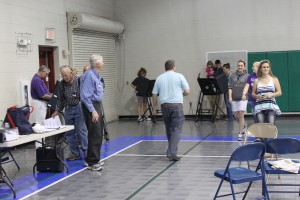
Cullowhee voters cast their ballots at the Jackson County Recreation Center. Photo by Ben Haines.

The amendment to North Carolina’s state constitution reads “marriage between one man and one woman is the only domestic legal union that shall be valid or recognized in this State.” The referendum has drawn national attention and impassioned controversy.

Sixty-one percent of North Carolina voters approved the amendment. Running contrary to Jackson County and the state as a whole, 55 percent of voters in Cullowhee opposed the amendment.

Same-sex marriage is already prohibited under N.C. statute 51-1.2.

Jackson County held referenda on alcohol sales, divided into four measures. With a 35 percent turnout, the majority of voters elected to permit the “on-premises” and “off-premises” sales of malt beverages and unfortified wine, the operation of ABC stores, and the sale of mixed beverages in hotels, restaurants, private clubs, community theatres, and convention centers throughout the county.

More than 2.1 million registered voters cast ballots in North Carolina. About 500,000 voted prior to Tuesday by absentee ballots or early voting, which ran April 19 through May 5.

North Carolina was one of three states that held a primary Tuesday, along with Indiana and West Virginia. Republican presidential hopeful Mitt Romney won all three.

Rick Santorum and Newt Gingrich remained on the North Carolina ballot despite previously suspending their campaigns for the Republican Party’s presidential nomination. Prior to their withdrawals from the race, Romney had failed to win a primary in any Southern state aside from Florida.

Full results:
North Carolina State Board of Elections
Jackson County Board of Elections

WCU not immune to racial profiling

After the shooting death of unarmed teenager Trayvon Martin in Florida shook up the country, the presence of racial profiling on the Western Carolina University campus was the focus of a discussion panel on Tuesday, April 17.

The event was hosted by the Department of Intercultural Affairs as part of WCU’s Black Awareness Week and was organized by student George Townsend, a junior majoring in psychology with a minor in race, ethnic, and gender relations. Townsend comes from a “nicer” area of Raleigh and as an African American he fears that the Trayvon Martin incident could happen close to home, to someone like his younger brother.

Martin, 17, an unarmed African American, was walking to his father’s fiancee’s house in a gated Sanford community when he was pursued and eventually shot and killed by George Zimmerman, 28, a neighborhood watch captain of Hispanic descent. Zimmerman has been charged with second-degree murder but claims he killed Martin in self-defense.

For the discussion panel, Townsend gathered four expert panelists from the WCU community: Dr. Cyndy Caravelis Hughes, Assistant Professor of Criminal Justice; Dr. Thomandra Sam, a licensed psychologist, culture and gender expert; Dr. Henry Wong, Director of Equal Opportunity and Diversity Programs with a master’s degree in rehabilitation counseling; and Rakim Lash, a junior political science major and the Director of Student Diversity Council for WCU’s Student Government Association.

Wong made the point that Zimmerman became the aggressor when, while making a 911 call, he continued to pursue Martin after a police dispatcher told him to stop.  Additionally, by having a gun while on patrol, Wong said that Zimmerman broke the state of Florida’s neighborhood watch guidelines.

“We push things to the forefront in media and then we tend to forget about these issues,” said Lash. He wants to make sure this issue does not go away and that people continue discussing the case.

Hughes brought up the issue of the media’s involvement in the case, arguing that certain media outlets tried to justify Martin’s death by finding pictures of him making offensive gestures.

“What kid do you know doesn’t have a picture of him flipping off the camera?” asked Hughes. “It is ridiculous to think that because you have pictures of him that some people might find rebellious, he was a thug and his death doesn’t mean anything.”

Wong cited national statistics from 2005 which indicate that police pull over blacks and Hispanics more often than white automobile drivers. Townsend then asked the predominantly African American audience if any of them felt like they had ever been the victim of racial profiling on campus.

Janae McKinney, a black student, recalled being the passenger in her friend’s car when they were pulled over by two campus police cruisers. After the first officer collected her friend’s license and registration and walked back toward his car, McKinney said she heard him say to the other officer, “It’s okay, she’s not black.”

McKinney refused to cooperate when the campus police officer asked for her identification because she felt offended by his words.

Wong closed the discussion by encouraging the audience to report instances of bias, harassment or hazing at WCU to the university’s Bias Response Team. “As students you guys deserve to be heard,” he said.

Victims of N.C. eugenics program seek justice

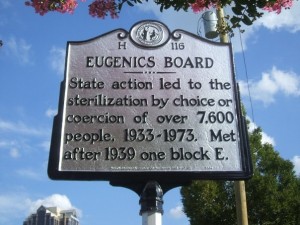
The location of the North Carolina Eugenics Board, dissolved in 1977, now has a historical marker at it's location in Raleigh, N.C. Photo: North Carolina Highway Historical Marker Program

While Elaine Riddick may look as though she has sailed through life without many troubles her story is a portrait of loss, sorrow and anger.

Riddick shared her story at the North Carolina Center for the Advancement of Teaching in Cullowhee, N.C. during the annual gathering of Holocaust educators. The seminar focused on teaching tolerance in relation to the Holocaust and its connection to eugenics programs across the country.

Her story sheds light on the North Carolina eugenics program that was in place for 45 years, a program that claimed over 7,600 victims.

Riddick was 14 when she gave a birth to her son and right after that she was sterilized without her knowledge. It was 1968; she lived with the grandmother who was poor and uneducated. The child was a result of a rape, but that seems not important. Her diagnosis was “feebleminded”. Riddick said that she still doesn’t fully understand what it really means.

“What does feebleminded mean? How were they able to label me as that? I’m smart, I’m not feebleminded,” protested Riddick.

Riddick was unaware that she was sterile until she tried to start a family with her husband when she was 18 living in Long Island, N.Y. After exploratory surgeries, doctors discovered that she had been sterilized, and explained that the hemorrhaging and abdominal pains she had since her teens were directly related to her sterilization.

Riddick said that her grandmother was forced to sign the papers allowing for her sterilization. Since her family was so poor, they relied heavily on community programs for food. Riddick learned from her grandmother that after her rape, somebody came to their house and forced her grandmother to sign the papers to allow for the sterilization, out of fear that their food source would be taken away.

“My grandmother couldn’t read. She didn’t know what she was signing. What would you do if somebody threatened to stop bringing you food?” asked Riddick.

North Carolina General Assembly passed the first sterilization law in 1919 but no sterilizations were performed at that time. Ten years later, in 1929, North Carolina passed the Sterilization Act along with 29 other states.

By 1933, the first case against sterilization was heard by the N.C. Supreme Court. The Court ruled that sterilization was unconstitutional based on lack of public hearings and the absence of patient notification. However, the same year, a new, more aggressive sterilization law was heard and passed by the U.S. Supreme Court which established the Eugenics Board of North Carolina, authorizing sterilization of the feeble-minded, mentally diseased and epileptics.

The North Carolina Eugenics Program in its 41 year existence approved sterilization of  more than 7,600 victims for being feebleminded, blind, unwed, or mentally retarded, among other reasons. The majority of victims were African-American.

The sterilization program ended in 1974, yet many victims have not received explanations for their sterilizations. Riddick, with the assistance of her son Tony, sought to find out more information on her procedure when she discovered her diagnosis.

She filed a civil lawsuit in 1983 in search of compensation for her sterilization, but lost.

Before Riddick spoke, N.C. House Representative Earline Parmon spoke to educators with urgency to compensate victims in any way. The eugenics program is still not widely known to many North Carolina citizens. Representative Parmon explained that throughout her political career, she has fought for equality for all people, yet has found it difficult to make strides in regards to the eugenics program. The most recognition that the state of North Carolina has made towards eugenics is a placard at the historical site of the North Carolina Eugenics Board.

Although North Carolina has had difficulty in assisting victims, the NC Justice for Sterilization Victims was formed in 2010 by Gov. Bev Perdue to provide justice and compensation for victims.

Charmaine Fuller Cooper, executive director of the NC Justice for Sterilization Victims, has been working to encourage victims to come forward.

“We want to make sure to provide assistance for people who have suffered sterilization,” said Fuller Cooper.

Fuller Cooper added that as more people come forward about their own sterilizations, others have found the courage to do so as well.

“You can be completely anonymous, we just want those who have suffered sterilization to know that there is somebody out there fighting for them,” said Fuller Cooper.

Although support for sterilization victims is available, in a statement from Gov. Bev Perdue on March 19, only 111 eugenics victims have been verified by the state.

On April 25, Gov. Perdue placed a $10.3 million request in her budget for sterilization victims. This would take up around two-third of Gov. Perdue’s budget for next year and would guarantee that all living victims would receive a $50,000 tax-free lump sum from the state of North Carolina. The $10.3 million would also support the North Carolina Justice for Sterilization Victims. The budget will be voted on during the annual session, beginning in May.

Many victims of sterilization in North Carolina have yet to come forward with their stories. Riddick has spent her life bringing awareness to the issue, in hopes that other victims will find the strength to tell their story. Accompanied with the NC Justice for Sterilization Victims and Gov. Perdue, awareness of the eugenics program in North Carolina is increasing, and sterilization victims are finding support that they need.

Read more on the eugenics program and its victims in the Winston-Salem Jounal special project Against Their Will: North Carolina’s Sterilization Program and in Carolina Public Press: New numbers show slow pace of IDing N.C.’s sterilization victims .


C-SPAN Campaign 2012 Bus visits WCU

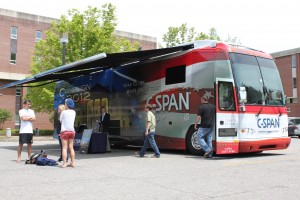
C-SPAN partners with Tout to hear what North Carolina students have to say about the 2012 campaign season. Photo by Ben Haines

C-SPAN launched its Campaign 2012 Bus on a six-day tour of universities and towns in North Carolina on Thursday, May 3, beginning with stops at Asheville-Buncombe Technical Community College and Western Carolina University.

Leading up to the state presidential primary on Tuesday, May 8, the C-SPAN Campaign 2012 Bus is partnering with social media service Tout to encourage students and the public to share their thoughts about campaign issues online. Tout allows users to post 15-second videos directly from their smartphones.

“It’s our community outreach and education vehicle,” said Doug Hemmig, C-SPAN community relations representative. After visiting Asheville in the morning, the Campaign 2012 Bus parked on the WCU campus in lot 33 by the A.K. Hinds University Center, Coulter and Forsyth buildings from noon to 2:30 p.m.

Visitors aboard the air-conditioned bus had the opportunity to learn about C-SPAN’s Campaign 2012 programming and resources with interactive touch-screen computers. Representatives from C-SPAN presented the Road to the White House website which features video of campaign events and information on state races.

Outside, Tout representative Katie Fountain guided visitors through the process of uploading 15-second videos to the social media website via smartphone. Some of the questions students addressed in the videos included “Which presidential candidate do you think will bring about the best job prospects for you and why?” and “What is the most important issue to you in this presidential election?”

“The key issue for this campaign season is people voting just for the sake of voting and not actually informing themselves about why they’re voting,” touted WCU senior Jeff Wilber.

See what else WCU students had to say on the C-SPAN Campaign 2012 Bus Tout page.

C-SPAN’s Campaign 2012 Bus will visit Winston-Salem on Friday, May 4, with stops at Wake Forest University from 10:30 a.m. to noon and High Point University from 1:30 p.m. to 3 p.m. The complete list of stops in North Carolina is available at c-span.org/bus.

Inside look at WCU’s NBA prospect Harouna Mutombo

Harouna Mutombo in the 2012 season. Photo by Doug Powell.

As children, many of us dream of being the next famous athlete.  Former WCU standout basketball player Harouna Mutombo has the opportunity to pursue his dream.

After graduating on May 5, Mutombo will embark on his journey to the NBA beginning with workouts in Virginia on May 15.  Here is a clip of just one day in the life of this basketball player.

Switch to our mobile site