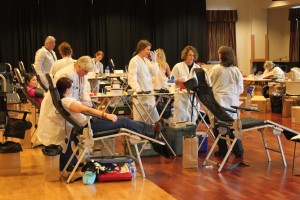
April blood drive comes up short

WCU students give blood on Wednesday, April 25.
Photo by Ben Haines

The American Red Cross held a blood drive April 24-25 at Western Carolina University but the donor turnout was significantly below the goal.

The Red Cross aimed to collect 135 units of blood on Tuesday and 130 on Wednesday but ended up with 76 and 82, respectively. It was the second of two multi-day blood drives that the Red Cross holds at WCU every semester in the A.K. Hinds University Center grand room.

Blood drives in April tend to draw the fewest WCU students, according to Eva Hyatt, team supervisor for the American Red Cross. “The end of the school year is right around the corner, so we don’t get as many students in here,” she said.

The previous multi-day blood drive that ran February 14-16 also failed to meet the Red Cross quota. The goal was to collect 100 units on each day but the final tally was 77 on the first day, 90 on the second and 97 on the third.

Blood donors must wait eight weeks before they can safely donate again and the Red Cross schedules blood drives at WCU accordingly.

Two additional, single-day blood drives earlier this semester were special occasions. The first took place on January 23 to coincide with the WCU stage and radio production of Bram Stoker’s Dracula. The second occurred March 27 as part of the Chancellor’s Installation Week events.

Both single-day blood drives took place in the UC multipurpose room and exceeded their comparatively modest goals. The January drive was meant to collect 35 units but it ended up with 44 in total. The March drive had a goal of 51 and yielded 60.

The Red Cross is planning another blood drive at WCU in June. The exact date has not been finalized but Hyatt hopes to hold it in the Liston B. Ramsey Regional Activity Center.


Related story: One-day blood drive goes beyond goal

A love for barrel racing

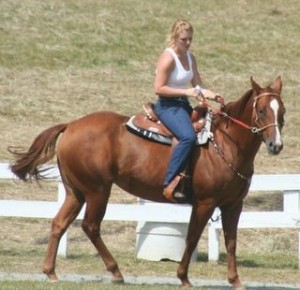
Hope Quinn and her horse Rio practicing barrel racing. Photo courtesy of Quinn.

Amongst the loud, rowdy crowd at a rodeo, a rider’s mind is set solely on speed. Nothing else is there except the horse and the barrels. While the stands watch in anticipation, their adrenaline pumps and blood rushes just as much as the rider. The passion in the eyes of both the rider, and the eager racehorse, burn like a blazing fire as they bolt together, like one unit, through the arena.

Hope Quinn, sophomore at Western Carolina University, has always felt this burning passion for riding horses, and she now feels it even more for barrel racing. Barrel racing is a rodeo event in which a horse and rider attempt to complete a clover-leaf pattern around preset barrels in the fastest time. Quinn just began competing in this event a little over a year ago. She has ridden horses at her home all of her life, but barrel racing always seemed to put a sparkle in her eye because of the thrill.

When the opportunity to barrel race finally came to Quinn, it was love at first sight. She got the opportunity by meeting her trainer, Susie Justice, at a local rodeo. What she enjoys the most about barrel racing is training her horse, Rio. Rio is an 8-years-old, liver chestnut Quarter horse.

“Being able to take a horse that has no previous experience and watch her grow and learn with me is the best feeling in the world,” said Quinn.

Quinn is a very optimistic rider, not letting her own rookie mistakes and failures stand in the way of success.

“I try to look at every ride, whether good or bad, as a learning experience. Personally, I have learned so much from all of the “bad” days that I don’t really consider them bad,” said Quinn. Quinn and Rio practice together at least four times each week.

Quinn has been to five Barrel Racing Exhibitions, where both she and her horse have increasingly progressed each time according to her scores. She is very proud of her horse and is excited about what the future will hold for the two of them in barrel racing.

There is no turning back after finding the love of a sport that is endlessly satisfying.  Horseback riders are taught throughout life that when you fall, you simply get back up again.  Quinn has lived by this rule her entire life, and is now incorporating it with her barrel racing.

Quinn is a member of the Equestrian Club at WCU. Although the team does not participate in barrel racing, they compete in Hunt Seat and Western competitions. The team practices at their coach’s farm in Waynesville, NC. Experience with horses or owning a horse is not a requirement in order to join the club or team. The competitions offer classes from beginner to open.

More information can be found by contacting Heather Crawford, at hccrawford1@catamount.wcu.edu.

Obama speaks at UNC Chapel Hill on college affordability

President Obama visited the University of North Carolina at Chapel Hill on Tuesday, April 24, 2012. During his discussion, Obama talked about college affordability, student loans and debt for students post-graduation. Obama also explained that he wants to keep interest rates on federal loans at the current 3.4 percent. If Congress takes no action, interests rates on federal loans will increase to 6.8 percent. Read more about Obama’s speech from UNC Chapel Hill.

Pedal Nick, pedal!

It was a rainy, windy day in Cullowhee, N.C. but that didn’t stop one student from ‘going the distance’.

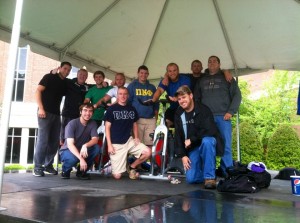
Nick Mashburn with some of his PKP brothers during the "Pedal for Push" event, 18 April 2012 at WCU. Photo by John Schmulling

Despite the gloomy weather, Nick Mashburn, a 21-year-old student and physical education major at Western Carolina University, spent Wednesday, April 18, on his bike pedaling for a cause.

Pedal for Push” is an event for Push America, supported  by Pi Kappa Phi Fraternity. Push America is a non-profit organization founded in 1977 through Pi Kappa Phi as a way for undergraduate members to experience leadership through service of people with disabilities.

Mashburn pedaled on a stationary bike for 4 hours on Wednesday with several other brothers from Pi Kappa Phi fraternity. Together they raised over $400. Seventy five percent of the proceeds will go to the national organization for Push America while the other 25 percent will go to an organization of Pi Kappa Phi’s choice, which is WCU’s University Participant Program.

The University Participant Program is a two-year, on-campus living and learning experience for people with developmental disabilities between the ages of 18 and 25. During the two year duration, participants need to complete requirements in order to receive a UP Certificate of Accomplishment. Many of the activities and goals for this certificate are individually designed for future goals, employment, education, and independent living.

Mashburn got involved with the UP program early last semester because some of the UPP participants live in the dorm where he works.

“I got involved with the program because the male participants didn’t have many male volunteers to spend time with. They had to spend their time with the female participants,” Mashburn said.

Over the course of this semester Mashburn has grown close to David Maennle, Manny Zayas, and Corey Hambrick. He plays basketball with them along with other sports. They also go to dinner together and attend sporting events.

“These are amazing people, I’ve been able to create a bond with the UP Participants and by working with the exceptional students at Cullowhee Valley”, Mashburn said. “This program can’t get enough help”.

For more information on WCU’s UP Program visit their page on the WCU website.


Unlikely student wins lead in play

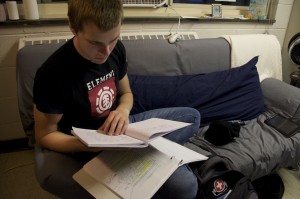
Phil Culton preparing for the role of a murderer in “The Why”. Photo by Jamie North.

A freshman at Western Carolina University took to the stage as the lead in the school’s performance of “The Why” while not even being a part of the Bachelor of Fine Arts program.

Phil Culton was beyond exited when he learned that he was going to play Robert in the mainstage performance of “The Why.” This was his first performance at Western Carolina. Culton’s first theater performance was as Billy Flynn in his high school’s performance of “Chicago” roughly a year from his performance in “The Why.”

Culton started college as a Nursing major but quickly  became undeclared. After working tech for “I Hate Hamlet,” sound for “Sweeny Todd” and becoming the lead for “The Why” he decided to audition for the Bachelor’s of Fine Arts major for acting and was admitted.

“It felt right and after working in theater I realized that’s what I wanted to do,” said Culton. “When I got the part I could tell the staff believed in me and had high expectations. I also knew I could make a career out of it.”

“The Why” is a play centered around the hard-hitting issue of school shootings. It follows the story of Robert, a teen that brought a gun to school and killed three of his fellow classmates. “The Why” follows the struggle Robert goes through with accepting what he has done. It was performed in March and successfully sold out all five shows.

Culton discussed how different acting is in a musical than acting in his first college performance.

“With Billy it was simply a costume character. I put it on right before each performance and that was it. But with Robert I had to find him within myself. I couldn’t simply act. I had to become Robert and it was difficult with no prior experience.”

Culton spent many hours researching his character. He needed to change from his driven enthusiastic self to the harden and  unreadable character that is Robert. Culton researched other school shootings and the motives behind them in order to find why Robert did what he did. He also began writing in a journal and wrote in it as Robert to help find his character.

“I don’t feel like I completely found out who Robert was,” said Culton. “I was close though. I think if I had more experience it would have been perfect.”

Culton plans to move to New York after he has completed his education but would also like to join a touring group.

2020 Commission unveils strategic plan draft

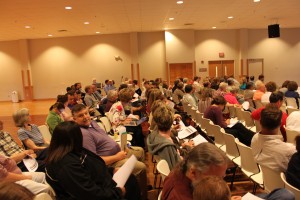
Members of the WCU community provided feedback at the 2020 Commission's public forum on April 17, 2012. Photo by Ben Haines

The 2020 Commission of Western Carolina University hosted a public discussion forum Tuesday, April 17 in the A.K. Hinds University Center to invite final feedback on its plans for university development.

The event was open to the public and drew university staff, faculty, students and alumni as well as members of the local community. The 2020 Commission debuted the draft of its strategic plan for the future of WCU and held a Q-and-A session.

The 2020 Commission is a committee of 36 people selected by Chancellor David O. Belcher in summer 2011 to determine priorities and establish goals for the growth of WCU as an institution through the rest of the decade. Twenty-six of the committee’s members are staff, faculty or students at WCU and 10 are external members.

Attendees at Tuesday’s forum found free printed copies of the strategic plan draft at the door. The committee will finalize the draft in May and submit it to the WCU Board of Trustees for endorsement in June, according to the university website.

“We’re not just putting a plan out there,” said Chancellor Belcher at Tuesday’s forum. “We’re putting people’s names by each individual thing so that we can know whom to hold accountable for seeing it through at the university.”

2020 Vision: Focusing Our Future – WCU Strategic Plan DRAFT

“Nothing is going to happen if we don’t have a champion to take it there, and we’re going to name those people,” the chancellor said. “They’ll be responsible and it’s part of their job descriptions.”

Audience members during the Q-and-A session made it clear that WCU’s socio-economic role in the region is an important consideration for many people. “A lot of our programs affect industry and employment well into the surrounding counties,” acknowledged 2020 Commission member Wesley Stone, associate professor of construction management and technology at the Kimmel School.


Related story: What will Cullowhee look like in 20 years?

Switch to our mobile site